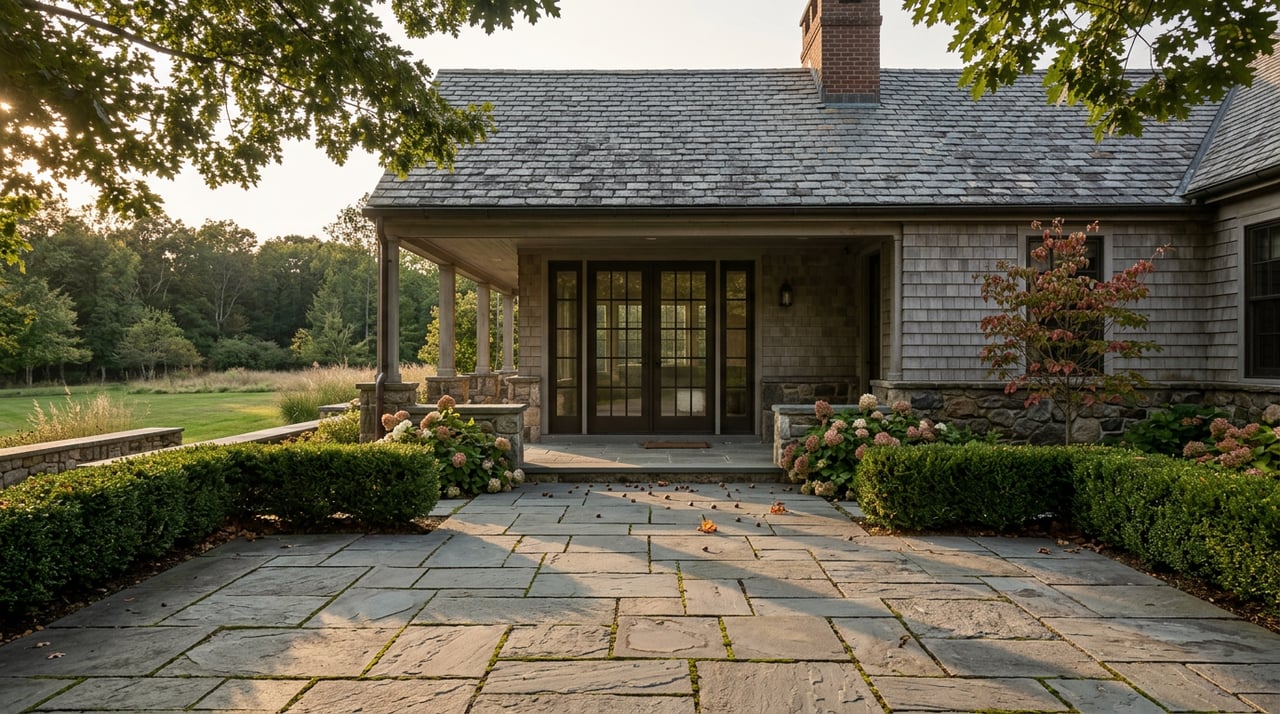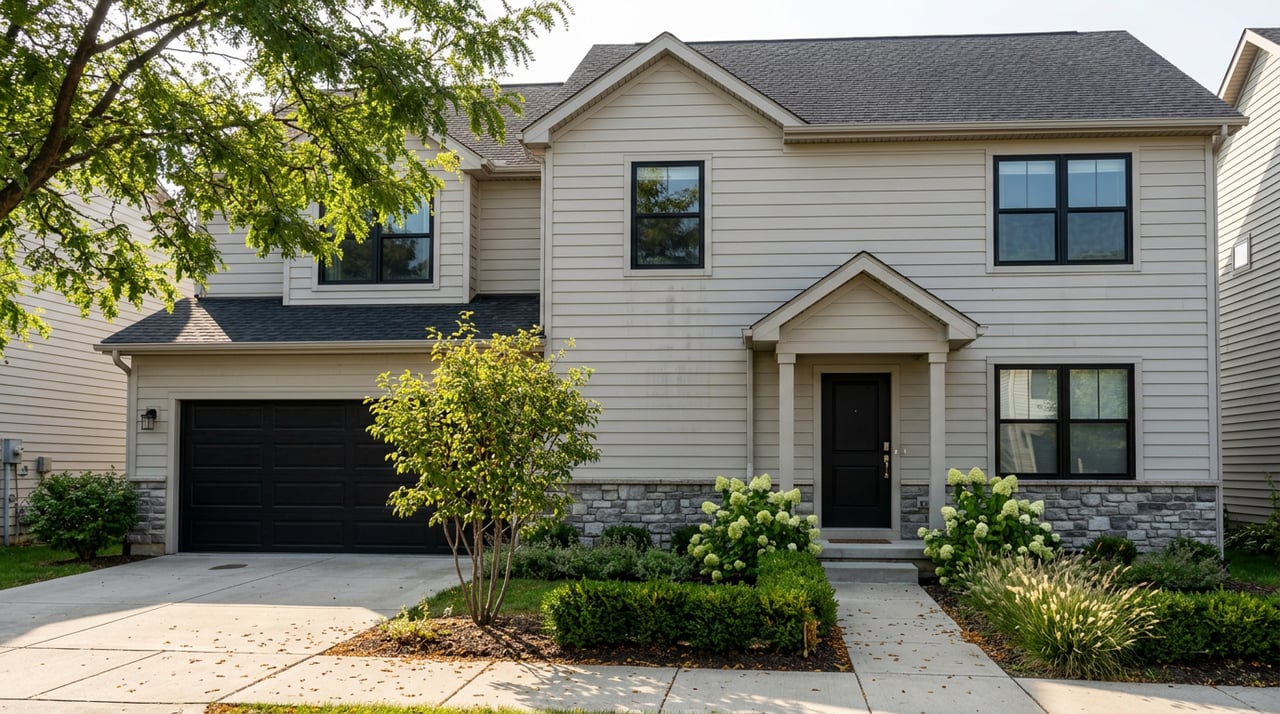
If you have been comparing Naperville to Wheaton, Downers Grove, or Arlington Heights on a portal, you have probably written down a single number for each town and moved on. For Naperville that number lands somewhere between $590,000 and $650,000 depending on which site you trust, and it is the least useful figure in your spreadsheet. The city is two markets sharing a name, and the median sits in the empty space between them.
The one number that hides everything
The headline data looks calm. The median sale price sits at $590,000, down 0.84% year over year, homes are moving in 43 days, inventory is at 0.63 months of supply, and properties are selling for 99.47% of asking price, according to Houzeo's April 2026 read. Redfin puts the trailing three-month median at $595,000 and the price per square foot at $273, up 3.4% since last year. Zillow's Home Value Index has the average Naperville home at $636,281 as of June 30, 2026, up 4.4% over the past year, with homes going to pending in around 10 days.
The interesting number is the one buried in the MRED trailing-12-month pull for detached single-family homes through March 2026: the flat median at -0.1% alongside a rising average of +4.5% indicates the upper end of the Naperville market is appreciating while the mid-market has stabilized. Two separate price stories, one median. That gap is where relocating buyers overpay or walk away for the wrong reason.
Two Napervilles, split at the county line
Naperville straddles DuPage and Will counties, and the county line is the single strongest predictor of what your dollar buys. The DuPage County portion (60540, 60563, 60565) tends to have older, smaller lots closer to the downtown core, while the Will County portion (60564, and part of 60565) offers newer construction on larger lots but is more car-dependent, and both sides have strong resale demand. School attendance boundaries follow the same seam. District 203 serves the older, more walkable DuPage County side, and District 204 serves the newer Will County side with larger lots.
Zillow's ZHVI by ZIP, pulled the same week, tells the split cleanly:
| ZIP | Typical location | Zillow ZHVI (mid-2026) |
|---|---|---|
| 60540 | Downtown / near BNSF Metra | $539,238 |
| 60563 | North Naperville / near Route 59 | $407,330 |
| 60564 | Far south / newer construction | $597,265 |
| 60565 | Southeast / mixed vintage | $525,857 |
Two things jump out. First, 60563 looks $130,000 cheaper than 60564, but a large share of 60563's stock is condo and townhome inventory feeding the Route 59 commuter market, not directly comparable to a 60564 four-bedroom. Second, 60540 carries a walkability and Metra premium that pushes it near 60564 despite dramatically older housing stock. Naperville has two Metra stations, the BNSF at downtown Naperville in 60540 and the Union Pacific West / Route 59 station in 60563/60564, and homes within walking distance of either station carry a premium, particularly the downtown BNSF station, where walkability to shops and restaurants compounds the commuter value. If you are a Loop commuter, this is one of the most durable pricing forces in the entire western suburbs.
What each budget actually buys
Portals let you filter by price. They do not tell you what you are looking at. Below is the same market broken into the three tiers where Naperville actually trades.
$500,000 to $575,000. This range opens up the detached market meaningfully, with older ranch homes, cape cods, and split-levels, many in established neighborhoods within the 60540 and 60565 ZIP codes, often dating from the 1970s through 1990s and partially updated, and well-priced, move-in-ready homes at the $500 to $575K level still attract competitive attention, particularly those in District 203 attendance boundaries near downtown. This is the tier where a strong pre-inspection walk-through and a firm, unemotional first offer matter most, because the pool of ready buyers here is thick.
$600,000 to $950,000. Expect $600,000 to $950,000 for a 4-bedroom detached home in most Naperville neighborhoods, with the $700K to $850K range where the most active 4-bedroom market trades. This is the core of the Naperville detached market, bracketing the $699,000 median and the $787,369 average, with updated 3- and 4-bedroom colonials and larger ranches in sought-after subdivisions like Cress Creek, Hobson West, and Oakhurst; homes in this range with strong school assignments and recent updates sell quickly, and the list-to-sale ratio at 99.4% means there is very little negotiating room on well-priced properties.
$1,000,000 and up. Naperville has a meaningful luxury tier, anchored by custom homes in White Eagle, Ranchview, and select newer developments near the 60564 ZIP code, and at this level Naperville competes directly with Burr Ridge and the lower end of the Hinsdale market; transaction volume is lower here, and individual home characteristics such as lot size, architectural quality, and subdivision amenities carry more weight than the town median. Detached price per square foot for standard resale runs $220 to $320, per the same MRED pull, with premium subdivisions pushing above that band.
One caution that applies to every tier on the Will County side: Naperville has a higher concentration of amenity-rich subdivisions than almost any other western suburb, with pool communities, golf course communities, and lake communities all commanding premiums over comparable non-amenity neighborhoods, and the trade-off is HOA fees and assessments, which buyers should factor into their total housing cost calculation. A $780,000 home in a golf course community with a $2,400 annual HOA and a periodic special assessment is not the same monthly number as a $780,000 home on a non-HOA street two miles north.
Where the 99.4% list-to-sale ratio actually breaks
The most quoted statistic in the Naperville market is that homes are selling near list. It is true in aggregate and misleading in practice. With the sale-to-list price ratio at 99.47% in April 2026, a remarkable 34.88% of homes sold above asking price, up from 21.51% last year. Read that again. A third of homes clear over ask, which mathematically requires another substantial share to close under ask. The ratio is an average, not a rule.
Where does the discount hide? Two places. First, longer-DOM inventory in the $900,000 to $1.4M tier in 60564, where buyer volume thins and individual home characteristics dominate. Move-up homes with larger square footage, premium subdivisions, newer construction, and higher-end finishes, including White Eagle and newer builds in the 60564 ZIP code, are well represented in this range, and buyers here typically have more time to evaluate than in the core median range, with negotiating room opening up modestly, particularly on homes that have been on the market more than 45 days. Second, homes that show poorly at any price point. In a market where homes sell at 99.4% of list price, condition matters; Naperville buyers at every price point are well-informed and compare carefully, homes that show well and are priced correctly sell fast, and homes that are overpriced or under-prepared sit, with days on market a number buyers watch closely.
The practical read for a relocating buyer: the negotiating leverage is not distributed evenly across town. It is concentrated in specific slices you have to hunt for, and the average masks that entirely.
Migration patterns reinforce why competition stays firm in the core tier. In January through March 2026, 11% of Naperville homebuyers searched to move out of Naperville while 89% looked to stay within the metropolitan area, and across the nation, New York homebuyers searched to move into Naperville more than any other metro followed by Washington and San Francisco. Out-of-metro buyers rarely have the bandwidth to shop the 60564 luxury discount patiently. They target the $600K to $850K core and press bids to close, which is exactly the tier where inventory clears fastest.
Questions buyers ask before they tour
Is Naperville a buyer's or seller's market right now? Naperville is currently a balanced market that leans slightly toward sellers, with only about 1 month of housing inventory, so sellers still have pricing leverage, but buyers have regained the ability to negotiate on repairs and contingencies. The leverage buyers regained shows up on inspection response, not on price.
Which ZIP has the largest supply of listings? Homes actively listed for sale account for 52.44% of residential properties in Naperville, IL, with 60564 containing 488 homes for sale, the highest number of listed properties in a single ZIP. That volume is a feature, not a warning. It is the primary reason the negotiating window opens on the Will County side rather than the DuPage side.
How fast should I expect to move on a well-priced 60540 home? The average 60540 home value is $539,238, up 4.3% over the past year, and goes to pending in around 7 days. Financing pre-approval, an inspector on standby, and a decision framework agreed with your co-buyer before you tour are the difference between winning and finishing third.
What about mortgage rates? Mortgage rates in Illinois are hovering around 6.15% to 6.46% for a 30-year fixed loan as of early May 2026, which is not cheap but it is stable, with rates having held in this range for most of the year and most economists expecting them to stay near 6% through the rest of 2026. Rate stability means the negotiating opportunities described above are unlikely to be papered over by a sudden rate drop in the next quarter.
The right way to shop Naperville is to pick your county side first, then your ZIP, then your subdivision, and only then your price band. Anchoring on a citywide median inverts that order and produces a shortlist that never quite makes sense. If you would like a side-by-side read on how a specific budget performs across 60540, 60564, and 60565, or on how a target subdivision's HOA structure changes your true monthly cost, Alka Patel can walk you through it. Let's Connect.